
Resources
Key Construction Requirements for Wine Cellar Performance.
Properly build your own Dream Wine Cellar.
The following information is provided as a guide for the creation of the proper environment in which to properly build your own Dream Wine Cellar.
Wall & Ceiling Framing
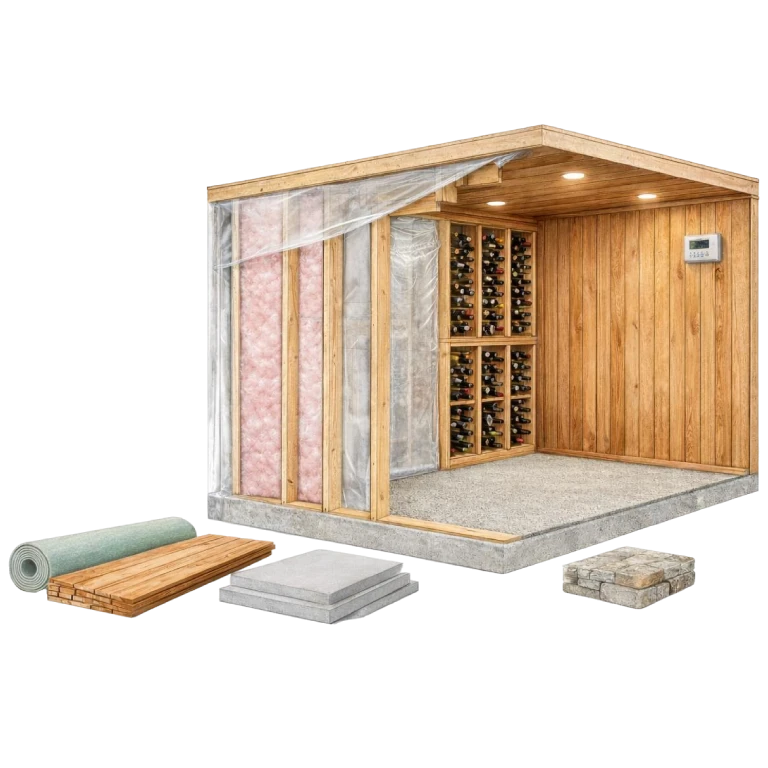
Wine cellar walls are built using standard 2" × 4" or 2" × 6" construction methods and ceiling joists, following the guidelines of local and state codes in your area. The general rule for a wine cellar is that thicker walls provide better insulation, helping the cellar maintain a more consistent temperature.
Vapor Barrier
A vapor barrier is REQUIRED on all wine cellars. Six-mil plastic sheeting is applied to the hot side of the cellar walls. The vapor barrier must be applied to the outside walls and ceiling; if access to the exterior is not possible, the plastic must be applied from within the cellar. The most common method is to wrap the entire interior, leaving the plastic loose in the stud cavity so insulation can be placed between each stud. All walls and the ceiling must be completely wrapped in plastic to create an effective vapor barrier.
Insulation
Insulation is REQUIRED when using a climate control cooling unit. The R-value or thickness of insulation is determined by the wall and ceiling thickness. For example, fiberglass insulation rated at R13 is designed for 2" × 4" walls, while R19 is used for 2" × 6" walls. It is important to use the correct insulation, with a minimum of R13 applied to cellar walls and R19 to R30 recommended for ceilings. Standard fiberglass or rigid foam insulation is commonly used, though blown-in insulation may be used in some cases. All walls and ceilings must be fully insulated to maintain consistent cellar temperatures throughout summer and winter months.
Wall & Ceiling Coverings
Interior wall and ceiling coverings are determined by the décor theme of the cellar. Drywall (green board) is often installed and painted using latex paint to match the cellar’s color scheme. Cedar or redwood tongue-and-groove paneling is the most commonly used wood material, applied to both walls and ceilings. This 1" × 4" T&G paneling typically matches the racking material, creating a uniform appearance throughout the cellar. Stone or granite may also be used as wall covering materials.
Cellar Doors
An exterior-grade (1¾") door must be installed as the cellar door. It is very important that weather stripping is applied to all four sides of the doorjamb, and a bottom sweep or threshold is also required. The door must have a tight seal to prevent cool cellar air from escaping. One of the most common causes of cooling units running continuously is poor or missing door sealing. Solid-core doors or doors with full glass inserts are most commonly used; glass doors must have at least double-pane tempered glass.
Flooring
Many types of flooring are used in wine cellars, with slate, tile, marble, and vinyl being the most common. Carpet should never be used, as it will mold and mildew in the cool, damp cellar environment. Flooring is typically selected to match the overall décor of the cellar and should be installed on a level surface. It is recommended not to apply base trim or moldings to walls behind the racking.
Lighting
Lighting is an important element of wine cellar design and décor. Air-lock recessed ceiling lights are the most popular option and should be installed on dimmer switches to control brightness. These lights are often used as the primary illumination within the cellar. Additional display lighting is commonly used to accent specific areas, such as bottle racks, display walls, or architectural features. Rope lighting designed to fit into racking display angles is also popular, along with spotlights used to highlight picture openings, table areas, or large-format bottles. It is recommended that all lighting be installed on a timer to ensure lights are turned off when not in use, as lighting generates heat and can cause cooling equipment to overwork.
Climate-Controlled Systems
When a climate-controlled cellar is required, cooling equipment should be provided to maintain temperatures between approximately 53–57°F and relative humidity levels of 50–70%.